
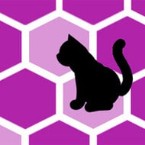












Trap the Cat
Why does a cat that only moves one dot at a time feel so hard to catch? Trap the Cat answers with a tiny strategy puzzle on a grid of circles: each turn you block one circle, the cat steps once closer to escaping, and if it reaches the edge of the board you lose.
| Genre | Turn-based puzzle |
|---|---|
| Board | Grid of circles in staggered rows |
| Your move | Block one circle |
| Cat's move | One step toward the edge |
| Win | Surround the cat so it cannot move |
How a Round of Trap the Cat Plays
The cat starts near the middle of the board, and a few circles are already blocked at random. You click any open circle to darken it, and then the cat moves to a neighboring circle.
Because the rows are staggered, every circle has six neighbors. That shape is the reason the cat slips through gaps that look closed at first glance.
A round lasts a minute or two. Losing is fast, and starting again is instant, which makes it easy to try a new plan right away.
Why Blocking Next to the Cat Fails
New players usually place blocks right beside the cat. It simply steps around them, and after a few turns it is running toward an edge with nothing in the way.
The better approach is to build walls further out. Blocking circles two or three steps ahead of the cat creates a barrier it reaches too late to escape around.
Players call this building a fence. Once the fence is wide enough, you tighten it until the cat has nowhere left to go.
How the Cat Thinks
The cat always looks for the shortest route to any edge. It does not wander randomly, so once you understand that rule, its next step becomes predictable.
When two routes are equally short, the cat picks one, and that choice is where good players gain an advantage. Blocking the meeting point of two routes cuts both at once.
In the final turns the cat gets stuck in a pocket of open circles. Closing that pocket one circle at a time is the satisfying end of every winning round.
Strategy That Works in Trap the Cat
- Look at which edge is closest to the cat and start blocking there.
- Leave the circles directly next to the cat open early on.
- Use the random starting blocks as part of your wall.
- Close the final gaps only when the fence is complete.
The starting layout matters a lot. Some boards give you a head start with blocks near the edge, while others leave a clear lane that you must close in the first few moves.
That randomness is the main debate. A few layouts are very hard to win, and some players feel certain rounds are lost before the first click.
Puzzle fans who like quiet planning, such as players of Suika Game, usually get hooked on the trapping loop.
Who Will Enjoy Trap the Cat
It is perfect for short breaks. There are no levels to unlock or menus to navigate, just one board and one cat.
Cat lovers enjoy the cute animal at the center, even though the puzzle is all about logic. The cat's little hops make every escape attempt feel lively.
Anyone who likes chess-style thinking will appreciate that you have to plan moves ahead rather than react to the last one.
Trap the Cat turns a simple grid into a test of patience and foresight. Build the fence early, keep your blocks away from the cat's nose and it will run out of circles before it reaches the edge.